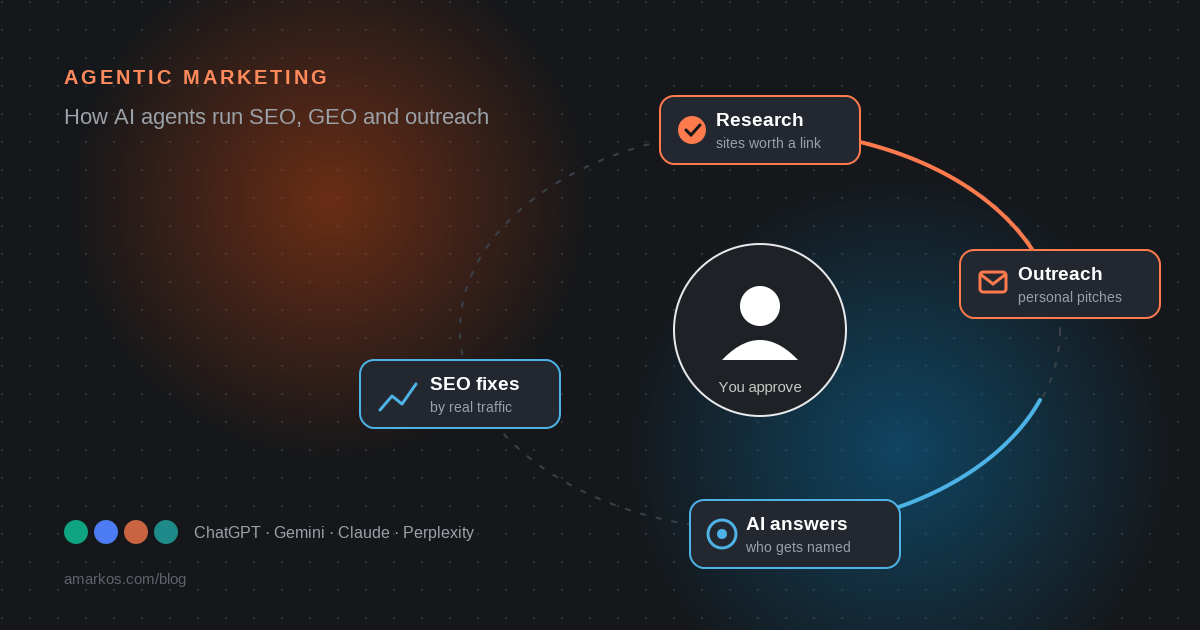
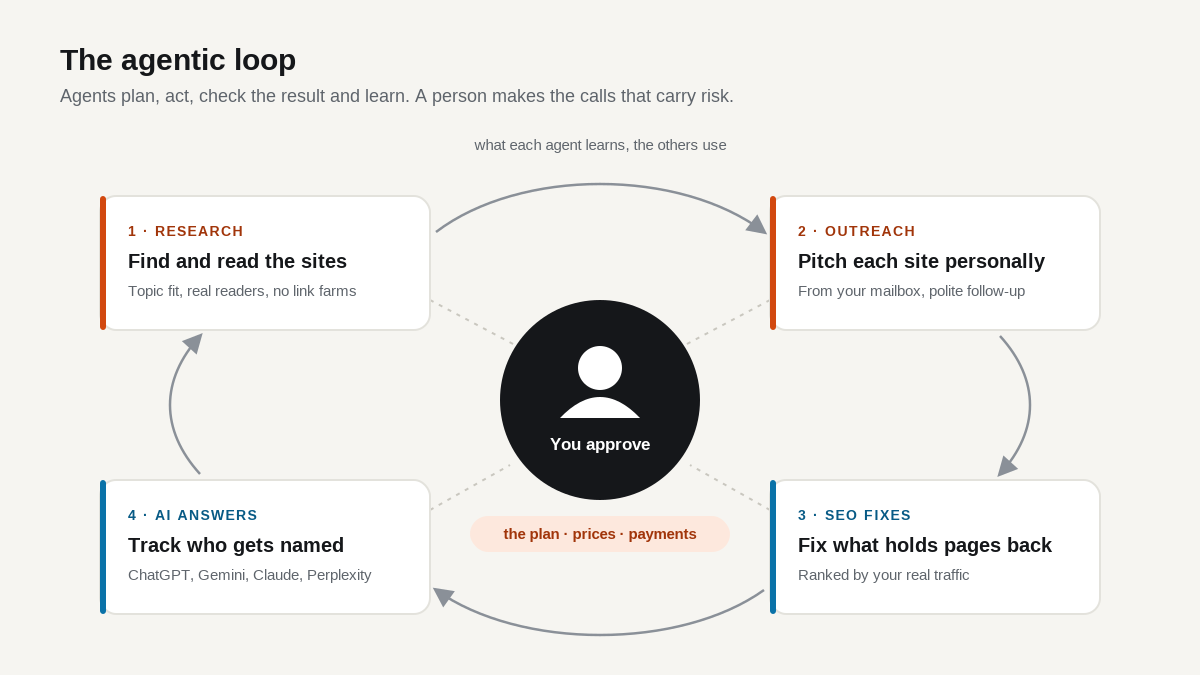
Agentic marketing is marketing work done by AI agents: software that is given a goal, plans the steps, uses tools such as search, email and analytics, checks its own results and keeps going until the goal is met, with people approving the decisions that matter. In search marketing that means agents that research the sites worth a link, write and send personal outreach, fix what holds a website back on Google, and track and improve what ChatGPT, Gemini, Claude and Perplexity say about a brand. This article explains what makes a system agentic, what agents can run end to end in SEO and GEO today, where people should stay in charge, and how to start.
What "agentic" actually means
The word gets stretched, so it helps to separate three kinds of software that all get called "AI marketing".
| Rule-based automation | AI assistant (copilot) | AI agent | |
|---|---|---|---|
| What starts it | A trigger you set up | You, with a prompt | A goal you set once |
| What it does | The same steps every time | One answer or draft per request | Plans steps, uses tools, adapts to what it finds |
| Who checks the result | You, later | You, every time | The agent checks its own work and brings you decisions |
| Example | Send a welcome email when someone signs up | "Write me an outreach email for this blog" | "Earn links from sites our customers read, inside this budget" |
Automation is reliable but blind: it cannot tell a good prospect from a link farm, or a friendly reply from an annoyed one. An assistant is clever but passive: it waits for you to ask, and the work of carrying an idea through twenty steps is still yours. An agent combines the two. It reasons about the situation in front of it, takes the next step, looks at what happened and decides what to do after that.
Four traits mark a system as genuinely agentic:
- A goal, not a script. You describe the outcome you want, such as more links from relevant sites or being named when buyers ask an assistant for a recommendation, and the agent works out the steps.
- Tools. It can search the web, read pages, send email from your mailbox, read your Search Console and Analytics data, and ask AI assistants questions.
- Memory and feedback. It remembers what it tried, what worked and what each site or contact said, and uses that next time.
- Judgment about when to stop and ask. A good agent knows which decisions are routine and which belong to a person, and it hands those over with the context needed to decide quickly.
Why search marketing suits AI agents
Most of the hours in SEO and outreach are not spent on strategy. They are spent searching, reading, sorting, writing, following up and checking. That work is repetitive, but it is not mechanical: every prospect site is different, every reply needs reading properly, and every page on your site has its own reasons for ranking or not. That combination of volume and judgment is exactly where agents do well and older automation did badly.
Search also has clear feedback. A link is live or it is not. A page ranks higher or lower. An AI assistant names you for a buyer's question or names someone else. Agents improve when they can see the result of what they did, and search gives them that signal week after week.
Finally, the field now has two fronts. Classic SEO still decides who gets clicks from Google. GEO, generative engine optimization, decides who gets named inside AI answers. The term comes from a 2023 research paper, GEO: Generative Engine Optimization, whose authors found that the way content is written and supported changes how visible it is in generated answers. Doing both well by hand doubles the workload. Agents make it realistic for a small team to cover both. Our guide to GEO and AEO vs SEO explains what changes between the two.
What AI agents can run end to end
Here is what an agentic marketing platform can realistically take off your plate today, split by the job it replaces.
Research and prospecting
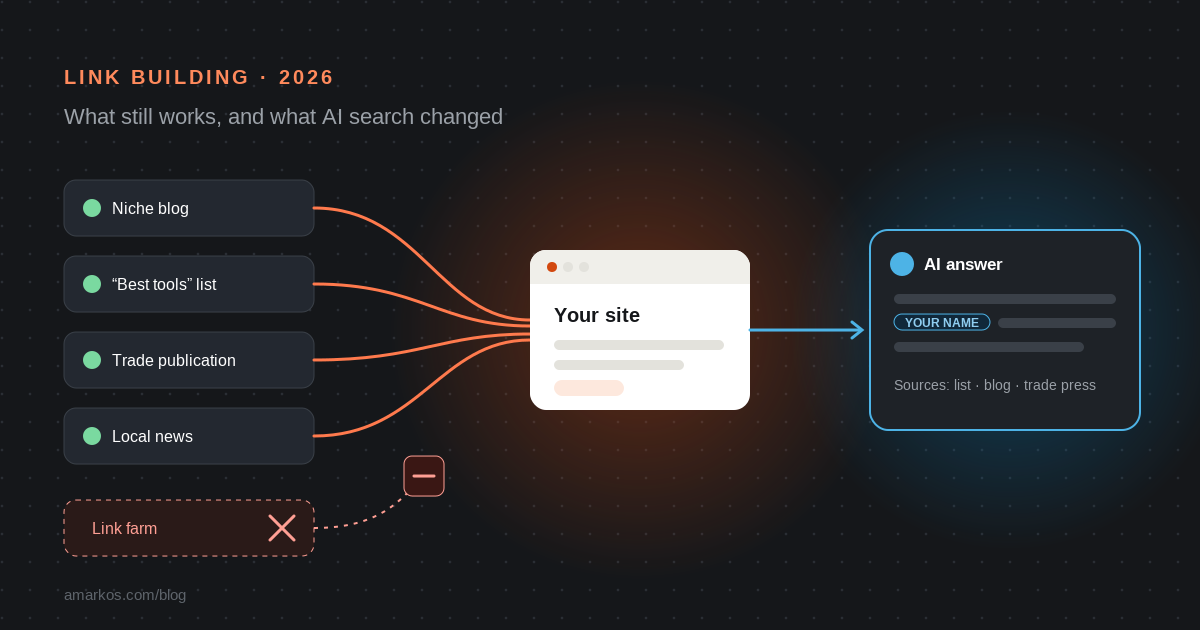
Finding sites that should link to you or mention you used to mean exporting long lists from backlink tools and reading them one by one. An agent can search for the topics your customers care about, look at who links to your competitors, find the pages AI assistants cite for your category, and then actually read each site. It judges topic fit, whether real people read it, whether it looks like a link farm, and whether there is a person to write to. The output is a shortlist with a reason for every site, rather than a spreadsheet of domains.
Outreach and relationships
Template outreach is why editors ignore most link requests. An agent can write each first email from the prospect's own page: the article it relates to, the gap your resource fills, the person's name. It sends from your own mailbox so replies and relationships stay yours, follows up politely when someone is quiet, reads replies, answers routine questions, and recognises when a reply needs you. When a site asks for a fee, it can work toward a fair price inside the budget you set and bring anything above it to you. Our guide on writing an outreach email that gets replies shows what a good pitch looks like.
Technical SEO and content
Site audits produce long lists of issues, and most teams never get through them. An agent can crawl your pages, connect each issue to your real traffic from Search Console and Analytics, and rank fixes by what they are worth, so a broken title on your best page comes before a missing alt text on a page nobody visits. It can research what the top-ranking pages cover for a query, draft content that answers the questions real readers ask, and explain each recommendation in plain words. The free rank gap tool gives a taste of this: it compares your page with the ones Google ranks above it.
GEO: tracking and improving AI answers
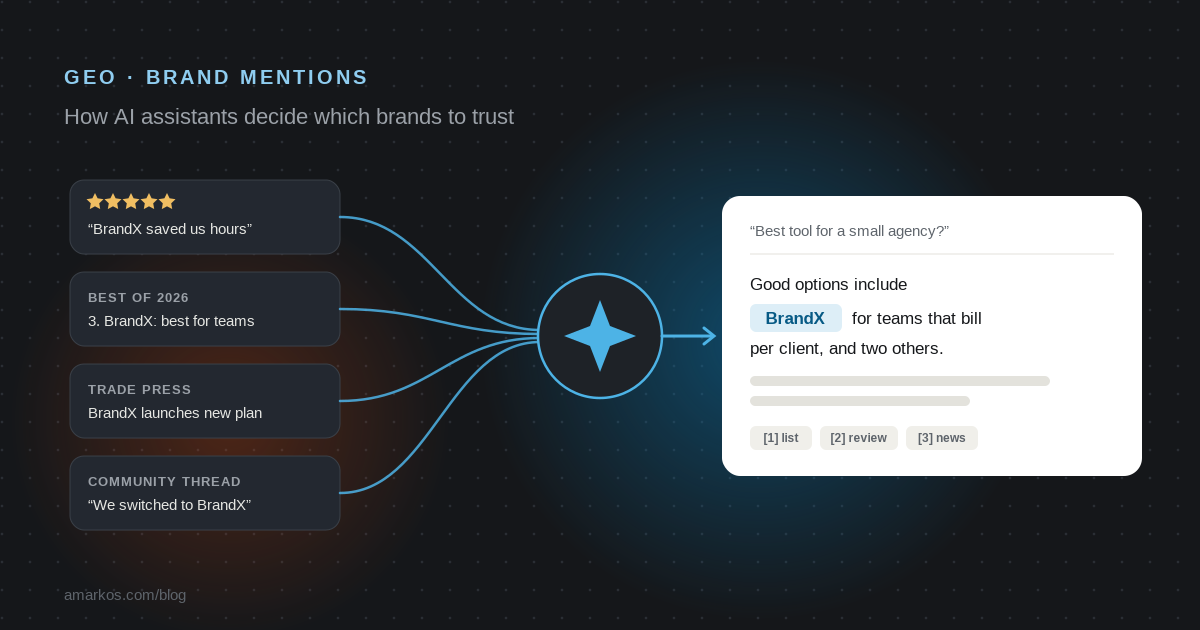
You cannot improve what you do not measure, and AI answers are hard to measure by hand because they change from one ask to the next. An agent can put your customers' questions to ChatGPT, Gemini, Claude and Perplexity on a schedule, with live web search on, and record who is named, in what order and which pages are cited. It then works backwards: if an assistant cites a "best of" list you are missing from, that list becomes an outreach target; if it cites your competitor's pricing page, your own pricing page becomes a content fix. We cover the measurement side in how to measure GEO.
Monitoring and upkeep
Links disappear. Pages change. A site you earned a link from turns it nofollow during a redesign. An agent can check every live link every day and tell you the day something changes, with a polite note ready asking for it back. It can also watch whether AI crawlers can still read your site, which matters more than most people realise: one careless robots.txt rule can keep you out of AI answers. The free AI crawler checker shows where you stand today.
Where people stay in charge
Agentic does not mean unsupervised. The best results come from agents that do the volume and people who make the calls. A sensible split looks like this:
- Strategy. You decide which topics, markets and pages matter, and you approve the research plan before anything is sent.
- Money. You set a budget per link, nothing above it is agreed without you, and no payment ever goes out without your approval.
- Your voice. You approve first emails until you trust the way the agent writes for your brand, and you can keep approving them for as long as you like.
- Sensitive moments. Anything negative, unclear or unusual, such as a complaint, a legal question or a request outside the normal pattern, waits for a person.
- Facts about your business. The agent can propose copy, but you confirm prices, claims and promises before they appear anywhere.
This split is not a compromise. It is what makes agents safe to run at volume. A team that approves ten decisions a week can oversee work that would otherwise need a full-time outreach person and a part-time analyst.
What to look for in an agentic marketing platform
If you are comparing tools, these questions separate real agents from automation with a new label:
- Does it read, or just filter? Ask to see why a prospect was kept or dropped. A real agent can tell you in a sentence that refers to the site itself.
- Whose mailbox does it use? Outreach from your own address builds your relationships. Outreach from a shared pool of domains builds theirs.
- What needs your approval, and can you change it? You should be able to start cautious and loosen controls as trust grows, never the other way round by surprise.
- Does it cover both SEO and GEO? Links, on-site fixes and AI answer tracking feed each other. Separate tools for each mean you do the joining up.
- Can you see everything it did? Every site, email, price and link should be visible with the reason it happened, not hidden behind a monthly summary.
- Is your data kept apart? Your research, plans and conversations should never be reused for another customer, and connected accounts such as Search Console should be read-only.
- Is pricing predictable? A flat price per site is easier to plan around than charges that rise with every action the agent takes.
The risks, and how to manage them
Agents bring new risks alongside the speed. None of them is a reason to avoid agentic marketing, but each needs a guard.
- Spam at scale. An agent that sends a thousand generic emails is worse than a person who sends ten good ones: it burns your domain's reputation. Look for personalisation from the prospect's own page, polite follow-up and a quality check before anything goes out.
- Link schemes. Google's spam policies treat buying links to manipulate rankings as link spam, and expect paid placements to carry
rel="sponsored". An agent should drop link farms and private blog networks at research, and help you label sponsored placements correctly. - Made-up facts. Language models can state things confidently that are not true. Keep facts about your business in one approved source, and make sure the agent writes from that rather than inventing claims.
- Tone. A sharp reply to an editor can end a relationship. Negative or uncertain messages should never go out without a person seeing them.
- Over-automation. Some work is genuinely creative, such as a data study pitched to journalists or a partnership built over coffee. Use agents for the volume and keep people on the work that needs a relationship.
How to start: a 30-day plan
You do not need to hand everything over at once.
- Week 1: measure. Run a free AI audit of your site, check which AI crawlers can read it, and put five of your customers' real questions to the main assistants. Note who they name and which pages they cite.
- Week 2: set the guardrails. Decide your topics, your budget per link and what needs your approval. Connect your mailbox and, read-only, your Search Console and Analytics.
- Week 3: let the agents research and pitch. Approve the research plan, review the shortlist and approve the first emails. Watch how replies are handled.
- Week 4: review and loosen. Look at what went live, what was agreed and what the assistants say now. Where you trust the work, reduce the approvals. Where you do not, keep them.
After a month you will know whether the agents earn their keep, with evidence rather than a sales promise.
How Amarkos fits
Amarkos is an agentic marketing platform for SEO and GEO. Its AI agents find the sites your customers read and pitch each one personally from your mailbox, secure fair prices inside your budget, keep every live link checked, rank site fixes by your real traffic, and track what ChatGPT, Gemini, Claude and Perplexity say about you every week. You approve the plan, the prices and the payments; the agents do the rest. See agentic link building, AI search visibility or, if you run campaigns for clients, Amarkos for agencies.
See in a minute whether AI assistants can read and cite your site, and the fixes that matter most.
Questions
Is agentic marketing the same as marketing automation?
No. Marketing automation runs fixed steps when a trigger fires, such as sending an email when someone signs up. Agentic marketing gives AI agents a goal, and they plan the steps, use tools, read the results and adapt, bringing people the decisions that need judgment.
Will AI agents replace my SEO team?
They replace the repetitive hours, not the judgment. Agents are good at searching, reading, writing first drafts, following up and checking. People are still needed for strategy, brand voice, budgets, relationships and anything sensitive. Most teams find they can cover more ground, including GEO, with the people they already have.
Is it safe to let an AI agent send emails for my business?
It is safe when the controls are right: emails come from your own mailbox, first emails wait for your approval until you trust the writing, anything negative or unclear waits for a person, and no money is agreed above your budget or paid without your approval.
What is the difference between SEO and GEO?
SEO is about ranking in search results so people click through to your site. GEO, generative engine optimization, is about being named and cited inside answers written by AI assistants such as ChatGPT, Gemini, Claude and Perplexity. They share a lot, including crawlable pages, clear answers and mentions on trusted sites, but they are measured differently.