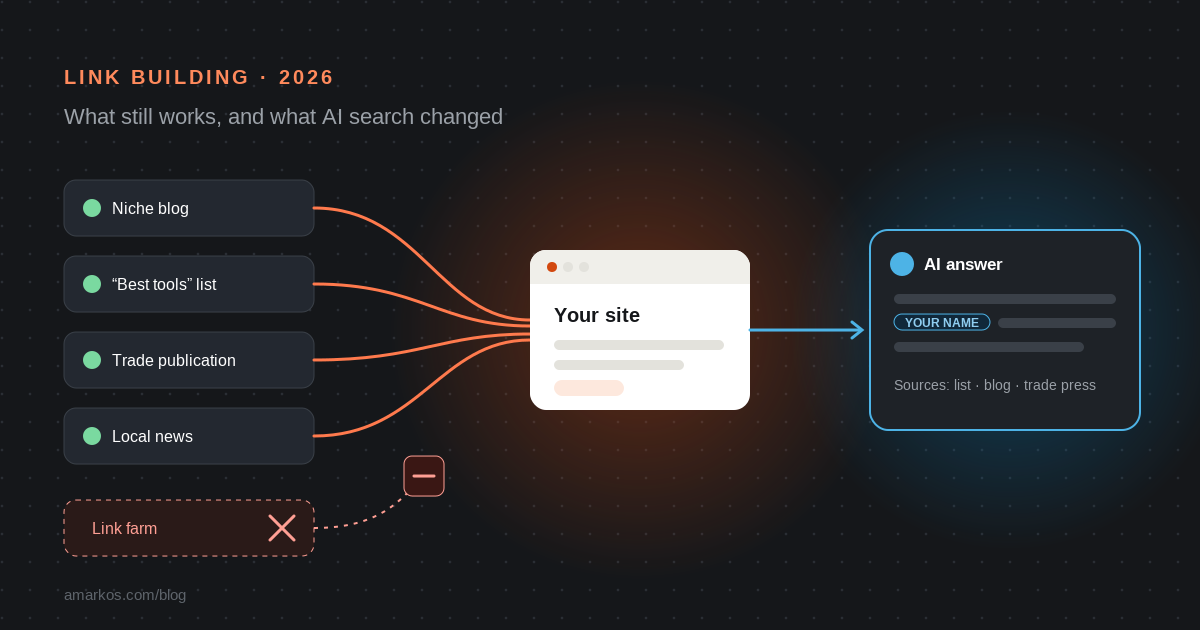
Link building still works in 2026, but the links that work have changed. Editorial links from real sites your customers read still help you rank on Google, and they now do a second job: the pages that link to you, list you and talk about you are the same pages AI assistants read before they recommend a business. What has stopped working is volume for its own sake: networks, swaps and mass guest posts on sites nobody reads. This article covers what AI search changed, the tactics that still earn their keep, the ones to drop, and a simple plan for the year.
Why links still matter
Links were the original idea behind Google: a link from one page to another is a vote that the second page is worth reading. Google's own documentation still describes links as a signal it uses to judge how relevant pages are, and as a way to find new pages to crawl. The weighting has changed many times, and nobody outside Google knows the exact formula, but ranking studies published by SEO tool makers keep finding the same pattern: pages that rank well for competitive searches tend to have links from other relevant sites.
What changed over the years is which links count. Google's spam policies treat links built to manipulate rankings as spam, including buying links that pass ranking credit, large-scale link exchanges and automated link creation. Since 2019 Google has asked for paid links to be marked rel="sponsored" and user-generated links rel="ugc". Its systems have become good at ignoring links that do not look editorial. The practical result: one link from a respected site in your niche can be worth more than a hundred from sites that exist to sell links.
What AI search changed
Google's AI Overviews, Google's AI Mode, ChatGPT search, Perplexity, Gemini and Claude all answer questions directly. That changes link building in three ways.
Answers cite pages, not just rank them
When an assistant answers "which accounting software is best for a small agency?", it usually searches the web, reads a handful of pages and writes a summary, often with the sources listed underneath. The pages it reads are frequently roundups, comparison articles, review sites, community threads and trade publications. If those pages mention you, you have a chance of being named in the answer. If they do not, you are invisible in that answer however good your own site is.
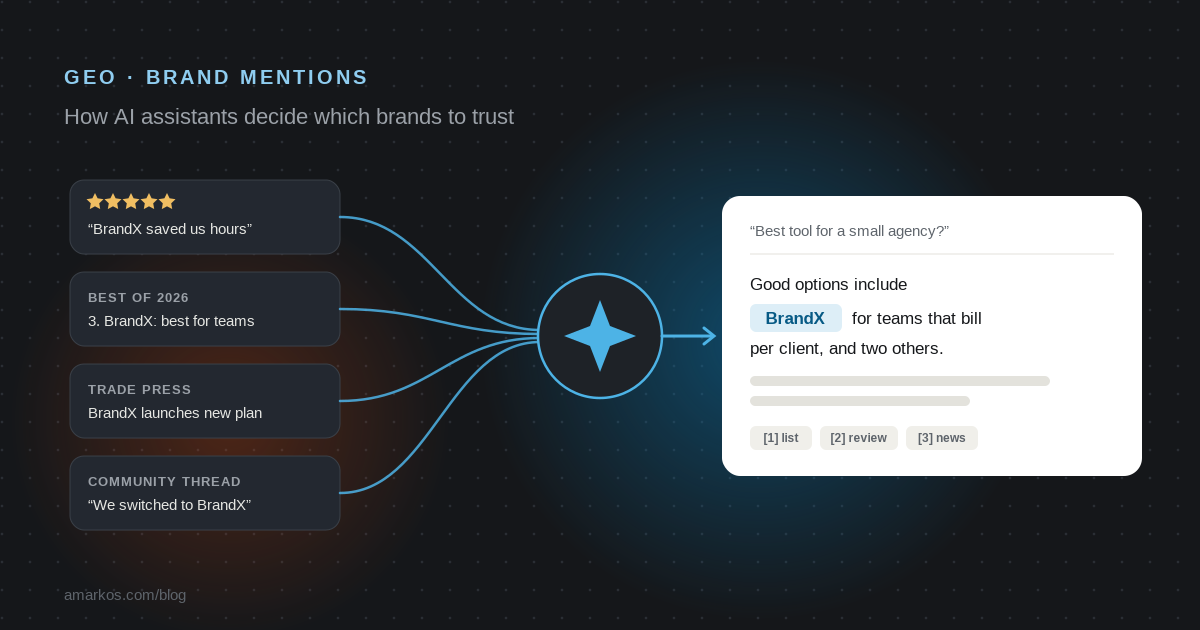
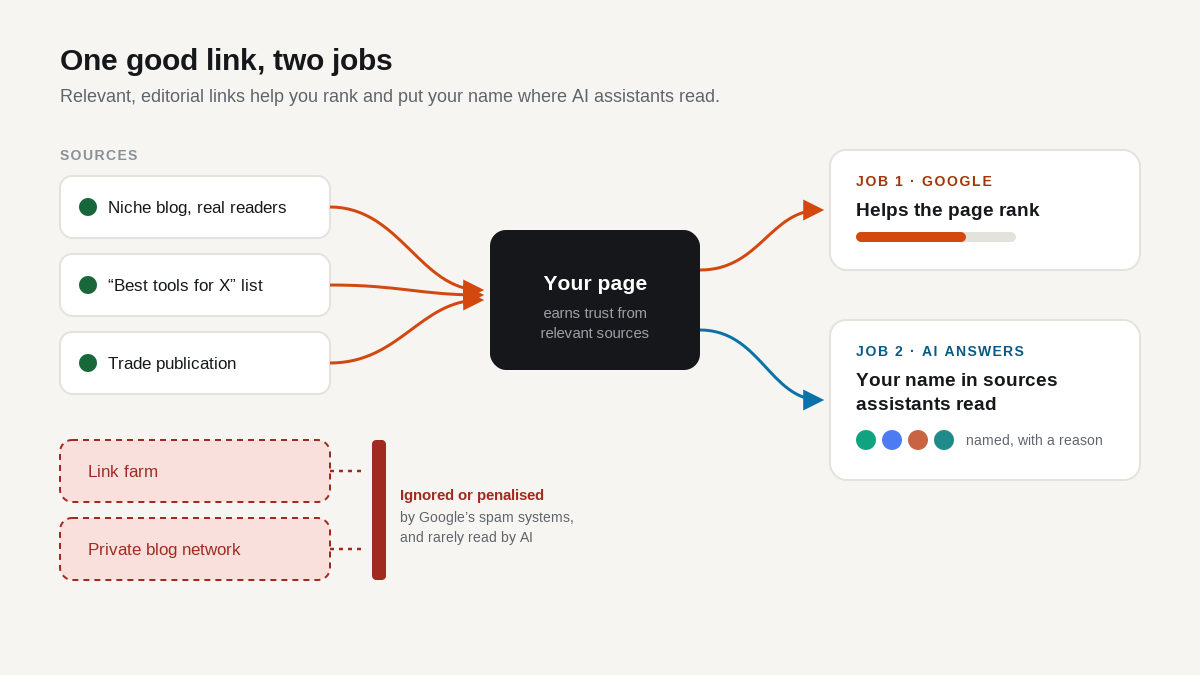
That makes some links valuable twice over. A place in a well-read "best tools for X" article is a link that helps your rankings, and it is also a mention inside a source the assistants read. Our post on brand mentions in AI search goes deeper into how assistants choose which brands to trust.
Relevance and mentions matter more than raw authority
Authority scores from SEO tools were always a rough guess at how much a link might help. In AI answers, what matters most is whether the source is about your topic and whether it says something specific about you. A small specialist blog that explains why it recommends your product can shape an answer more than a big general site that lists you in a footer. Even unlinked mentions count for something here, because the assistant reads the text, not just the link.
Fewer clicks, more value per mention
AI answers satisfy some questions without a click. That means fewer visits from some informational searches, and more weight on the moments when someone does click, often a buyer who has already been told your name. Links and mentions that put you in front of people at the comparison and decision stage are worth more than ever. Links that only existed to nudge a ranking number are worth less.
What still works
These tactics still earn links that help in both Google and AI answers. None of them is new; what is new is that they are clearly better than the shortcuts.
| Tactic | Why it works | What to watch in 2026 |
|---|---|---|
| Resource and "further reading" pages | Editors already link out to useful material on the topic | Offer a page that genuinely fills a gap on their list |
| "Best of" lists and roundups | Buyers and assistants both read them at the decision stage | Earn a place with facts the author can check, such as pricing, a trial or a demo |
| Guest posts on real sites | A useful article for a real audience earns an editorial link | Write for their readers, not for your anchor text; avoid sites that publish anything for a fee |
| Digital PR and original data | Journalists and bloggers cite new numbers and clear findings | Publish your own data honestly; one strong story beats ten weak ones |
| Unlinked mentions | Sites that already name you are the easiest yes | A short, friendly note asking them to add the link to your page |
| Partners, suppliers and customers | Real relationships produce real links | Case studies, integration pages and "where to buy" lists |
| Local and community sites | Associations, local news and events are trusted locally | Sponsor or contribute where you genuinely take part |
| Expert commentary | Writers need quotes from people who know the subject | Answer specific questions quickly and with substance |
| Broken link replacement | You help the editor fix a dead link | Only works when your page is a real replacement for what was lost |
A few principles run through all of them. Pitch a specific page for a specific reason. Write to a named person. Make it easy for the editor to say yes. And accept that some of the best links come with no fee at all, because the editor wanted the resource.
What to stop doing
These still get sold every day. In 2026 they are a waste of money at best and a risk at worst.
- Private blog networks (PBNs). Sites built only to link out, often on expired domains, are exactly what Google's spam systems are designed to find. Google's spam policies name expired domain abuse explicitly.
- Link exchanges at scale. "I'll link to you if you link to me" between two real partners is normal. Networks of hundreds of sites swapping links are a pattern search engines recognise.
- Paid links passing ranking credit. Sponsored placements are fine if they are marked
rel="sponsored". Paying for a followed link to manipulate rankings breaks Google's policies, and a site that sells them openly is also selling to everyone else. - Mass-produced guest posts. Hundreds of thin, AI-written articles on sites that publish anything are both spammy and pointless: nobody reads those sites, and assistants rarely cite them.
- Sitewide footer and sidebar links. One link repeated on every page of another site looks like a deal, not an editorial choice.
- Comment and forum spam. Links dropped into comments and threads are nofollowed, ignored and damaging to your brand. Genuine participation in communities is valuable; spam is not.
If a provider promises a fixed number of high-authority links every month at a flat low price, ask how. The honest answer is almost always one of the tactics above.
How to judge a link opportunity in 2026
Before you pursue a site, and especially before you pay one, run through these questions. Our guide on checking a site before you pay covers each step in detail.
- Do real people read it? Look for steady organic traffic, comments, social shares and named authors, not just a high authority score.
- Is it about your topic? A relevant small site beats an irrelevant big one.
- Does it have editorial standards? Look at what else it publishes and who it links to. If every post links to casinos, loans and unrelated shops, walk away.
- Do AI assistants cite it? Ask the main assistants a few of your customers' questions and note the sources they list. Sites that appear there are worth more to you now.
- Will the link be indexed and followed? Check that the page is in Google and that existing outbound links are not all nofollow, unless you are knowingly buying a sponsored placement.
- Is the price fair? Prices vary wildly. Our guide to what links cost gives typical ranges, and negotiating a sponsored post price explains how to agree a fair one.
A link plan for the year
A simple quarterly rhythm keeps link building steady without becoming a full-time job.
- Quarter 1: foundations. Fix your own house first: make sure AI crawlers and Google can read your important pages, your facts are consistent everywhere, and you have pages worth linking to, such as a useful guide, a pricing page that answers the question, or a tool. Reclaim unlinked mentions.
- Quarter 2: the decision-stage sources. Find the roundups, comparison pages, directories and review sites that rank for your category and that assistants cite. Work to be included in each, with accurate information.
- Quarter 3: earned attention. Publish one piece of original data or a genuinely useful resource, and pitch it to the writers and editors who cover your topic. Add expert commentary where you can.
- Quarter 4: relationships and upkeep. Turn partners and happy customers into case studies and integration pages. Check every link you earned this year is still live and followed, and ask for any lost ones back.
Throughout the year, keep a steady trickle of personal outreach to relevant resource pages and blogs. Consistency beats bursts.
Measuring link building now
Counting links is no longer enough. Track these instead:
- Live and followed links, checked regularly, because links are removed and changed more often than most people expect.
- Referral visits from the sites that link to you, in your analytics.
- Rankings and clicks for the pages you built links to, in Search Console, rather than your site as a whole.
- Mentions in AI answers for your customers' questions, and which sources the assistants cite. The free Does AI recommend you? check is a quick way to see where you stand, and how to measure GEO explains how to track it properly.
How Amarkos helps
Amarkos runs link building with AI agents. They find the sites your customers read, including the lists and sources AI assistants cite, and set aside link farms before anyone is contacted. They write each editor a personal pitch from their own page, send it from your mailbox, follow up politely, secure fair prices inside your budget and keep every live link checked. You approve the plan, the prices and the payments. See agentic link building, or start with a free AI audit.
AI agents find the sites your customers read, pitch each one personally from your mailbox and keep every link live.
Questions
Do backlinks still matter for SEO in 2026?
Yes. Google still uses links to discover pages and judge their relevance and importance, and pages that rank for competitive searches usually have links from relevant sites. What has changed is that links built only to manipulate rankings are ignored or penalised, so relevance and real editorial choice matter far more than volume.
Do backlinks help with AI search and GEO?
Indirectly, and often a lot. AI assistants read sources such as roundups, reviews, trade publications and community threads before answering. Links and mentions on those pages make it more likely you are named in the answer, and the same pages often help your Google rankings too.
Are paid links allowed?
Paying for a placement is allowed if the link is marked rel="sponsored", so it does not pass ranking credit. Paying for a followed link to manipulate rankings breaks Google's spam policies. Either way, judge a paid placement by the readers it reaches, not just the link.
How many links do I need?
There is no fixed number. It depends on your niche, your competitors and the pages you want to rank. A handful of relevant, editorial links to the right pages usually does more than dozens of weak ones. Look at the sites linking to the pages that outrank you to get a realistic picture.