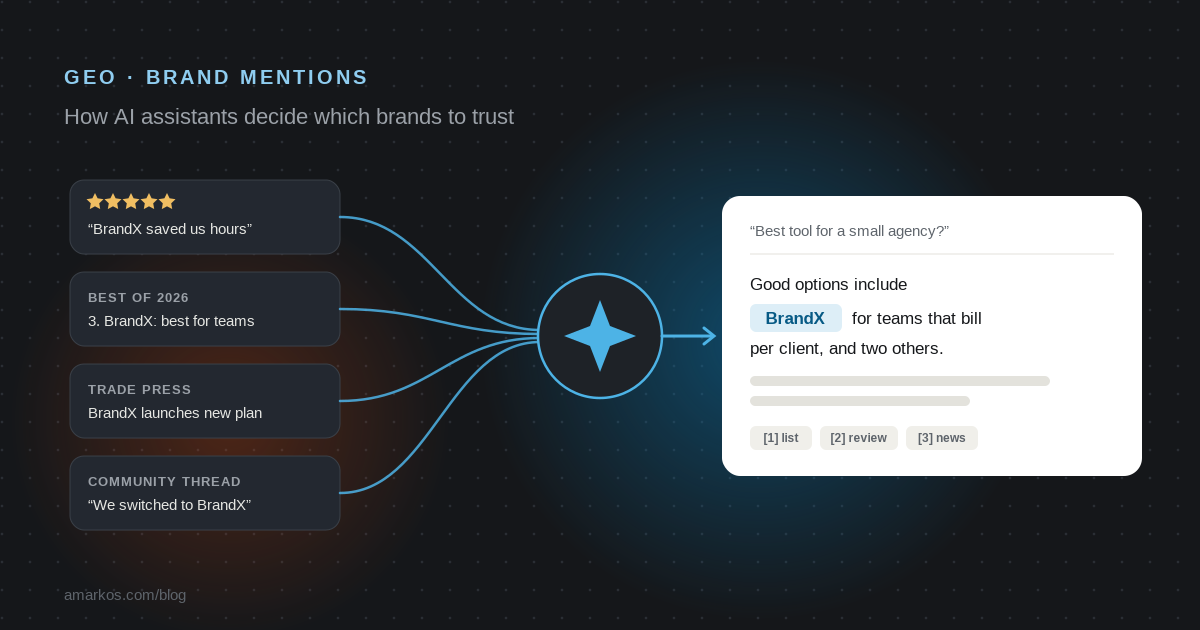
AI assistants decide which brands to recommend largely from what other people say about them. When ChatGPT, Gemini, Claude or Perplexity answers "what is the best project management tool for a small agency?", it draws on what it learned in training and, increasingly, on pages it reads live: roundups, reviews, comparison articles, community threads and trade press. A brand that is mentioned consistently, specifically and positively across those sources is far more likely to be named than one that only describes itself well on its own website. That is why brand mentions have become as important as backlinks. This article explains how assistants weigh sources, which mentions count, and how to earn the ones that change the answer.
How an assistant decides which brands to name
There is no published formula, and each assistant works differently, but the broad shape is well understood and consistent with what the companies themselves describe.
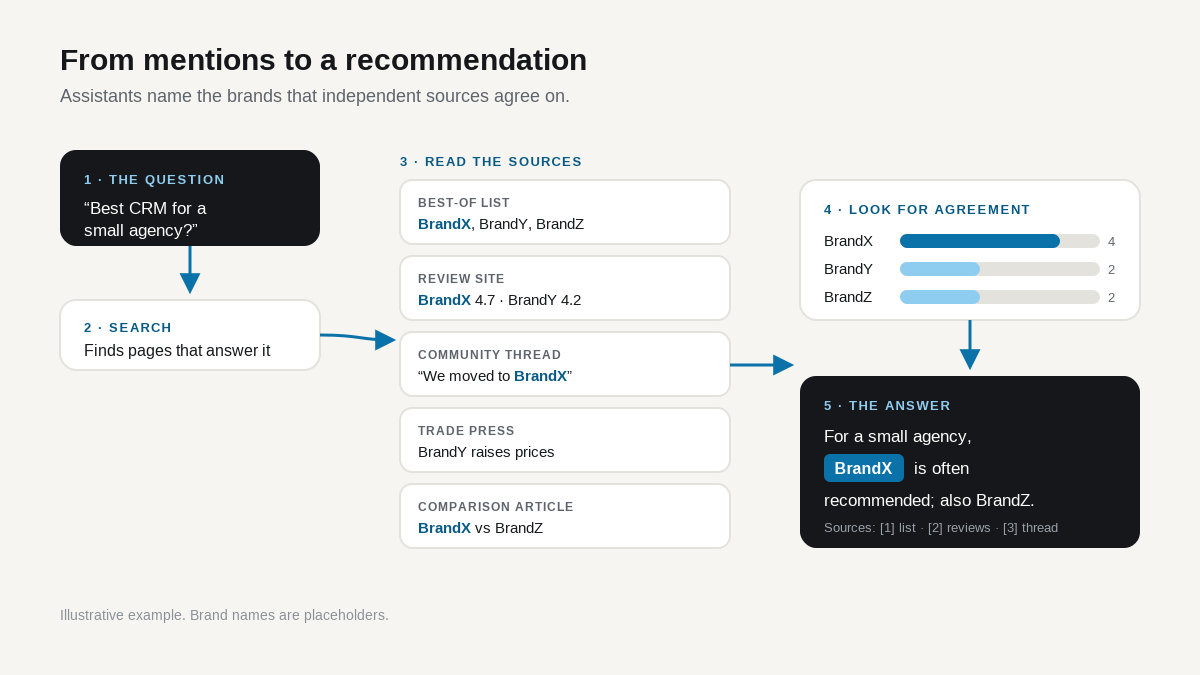
- It reads the question. It works out what kind of answer is wanted: a list of options, a single recommendation, a comparison, a local business.
- It may search the web. For questions about products, services and recent events, assistants with search switched on look up pages, much as a person would. ChatGPT search, Perplexity, Gemini, Claude with web search and Google's AI Overviews all show the sources they used.
- It reads a handful of sources. Typically a mix of articles, lists, reviews and discussions that rank well for the query or closely related ones.
- It looks for agreement. Brands that several independent sources name, for similar reasons, are safer to recommend than a brand that appears once.
- It blends in what it already knows. The model's training data gives it a background picture of which brands are associated with which categories.
- It writes the answer, usually naming a few options, often with a short reason for each and, where search was used, links to the sources.
Two things follow from this. First, your own website matters, but mostly as a source of accurate facts; on its own it rarely convinces an assistant that you are the one to recommend. Second, the job is not to trick the model. It is to make sure the sources it trusts contain an accurate, specific and consistent picture of you.
Why mentions matter as much as links
In classic SEO, a mention without a link did little for rankings. In AI answers, the text itself is what the assistant reads. A sentence such as "for agencies on a budget, we recommend BrandX because it bills per client" tells the model three things at once: BrandX exists, it belongs to this category, and here is a reason to choose it. That sentence helps whether or not it is linked.
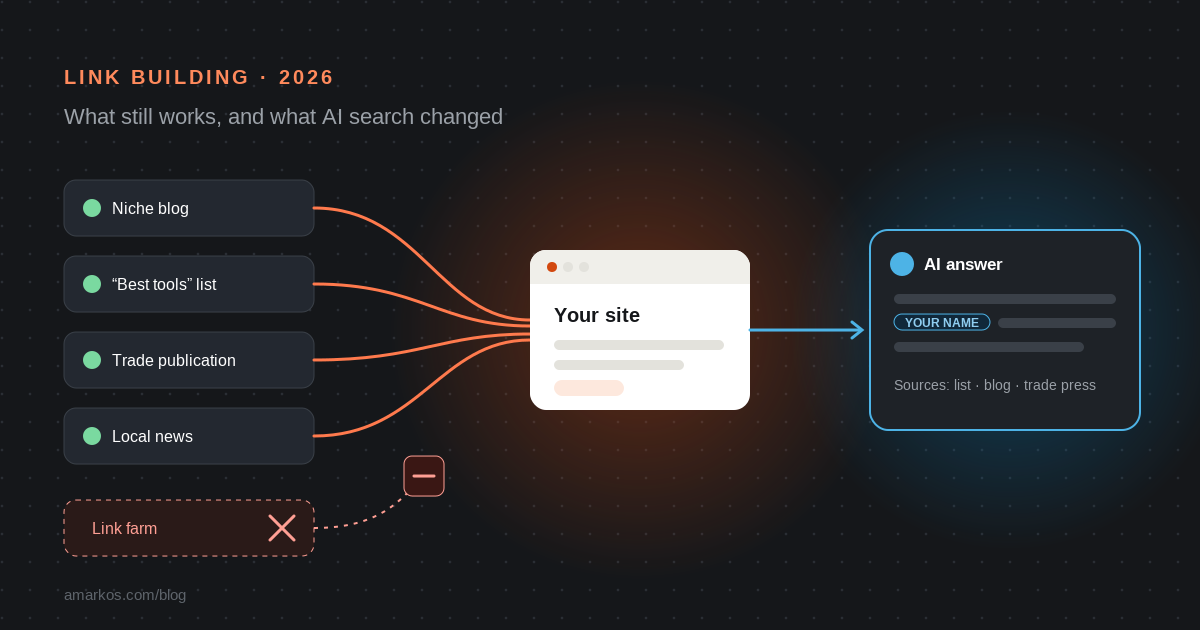
Links still matter, for Google rankings and because linked pages are easier for crawlers to connect to you. But when you plan outreach in 2026, the question is no longer only "will they link to us?" It is also "will they describe us accurately, in the context our customers ask about?" Our post on link building in 2026 covers the link side; this one is about the words around it.
The kinds of mentions that count
Not every mention carries the same weight. These are the sources assistants tend to lean on for buying questions.
| Source | Why assistants use it | How to earn a mention |
|---|---|---|
| "Best of" lists and roundups | They answer the exact question buyers ask | Give the author checkable facts: pricing, a trial, a clear difference |
| Review platforms | Many independent opinions in one place | Ask real customers to review you where your buyers look |
| Comparison and alternatives articles | Buyers ask "X vs Y" and "alternatives to X" | Publish fair comparisons yourself and offer facts to writers who cover your space |
| Community threads | Real people describing real experiences | Take part genuinely, disclose who you are, answer the question asked |
| News and trade press | Editorial judgment and recency | Original data, expert comment, real news about your company |
| Directories and associations | Basic facts: who you are, where, what you do | Complete and correct profiles on the ones that matter in your industry |
| Videos and podcasts | Transcripts are text that can be read | Appear as a guest where your buyers listen |
For local businesses, the mix tilts toward review platforms, maps listings, local news and local "best of" articles. For software, it tilts toward review sites, comparison articles and community discussion. For e-commerce, gift guides, product roundups and reviews do much of the work.
Find the sources the assistants already use
Before you pursue a single mention, find out what the assistants read today for your customers' questions.
- Write down ten real questions. Use the words customers use: "best", "cheapest", "for small teams", "near me", "vs", "alternatives to". Include your category and your two main competitors.
- Ask each assistant, with search on. Use ChatGPT, Gemini, Claude and Perplexity, and look at Google's AI Overview where one appears. Use a fresh chat each time.
- Record who is named and which sources are cited. Perplexity numbers its citations; ChatGPT and Gemini list sources under the answer; AI Overviews link to pages.
- Look for repeat sources. A list or review site that appears for several questions and in several assistants is a priority target.
- Note what is said about you, if anything. Wrong facts, old prices or a missing product line are worth fixing at the source.
The free Does AI recommend you? check does the first pass for one question, showing who ChatGPT, Perplexity and Gemini name and which pages they cite.
Earning mentions: a practical playbook
With the source list in hand, work through it in this order. The early steps are cheap and make the later ones work better.
1. Fix your own facts first
Make sure your website says clearly what you do, who it is for, where you operate and what it costs, near the top of the relevant pages. Use the same name, category and description everywhere, including your social profiles and directory listings. Add structured data, such as Organization, Product or LocalBusiness, so machines can read the basics without guessing; the free schema generator helps. And check that AI crawlers are allowed to read your site with the AI crawler checker. Our guide to getting recommended by ChatGPT covers this groundwork step by step.
2. Get onto the lists that already rank
Roundup authors update their articles, often yearly. Write to the named author with a short note: what you do, how you differ from the options already listed, and the facts they would need to include you, such as pricing, a free trial or a demo account. Do not ask for a ranking or offer to write the entry for them; offer to make their article more complete.
3. Ask customers for reviews where buyers look
Reviews on the platforms your buyers use carry weight with people and with assistants. Ask happy customers at the right moment, make it easy, and never write or buy reviews. In the United States the FTC has banned fake reviews and testimonials, and platforms remove them; elsewhere, consumer regulators take a similar view.
4. Join conversations honestly
When people ask in communities for recommendations in your category, a helpful answer from someone who works at a company, clearly saying so, is usually welcome. A wave of new accounts praising the same product is not, and moderators remove it. Answer the question first and mention yourself only where it genuinely fits.
5. Give writers something worth citing
Original data, a clear point of view, a useful free tool or a well-made guide gives journalists and bloggers a reason to mention you that has nothing to do with a link request. Pitch it to the writers who cover your topic, one at a time, with a line about why it matters to their readers.
6. Use your relationships
Partners, suppliers, integrations and customers can all mention you in a context that makes sense: a case study, an integrations page, a "where to buy" list, a joint webinar. These are among the most credible mentions you can earn.
Keep your story consistent
Assistants look for agreement. If one list calls you "an accounting app for freelancers", another "a payroll tool" and your own site "a financial operating system", the model has three weak signals instead of one strong one. Pick one plain description of what you are and who you are for, and use it in your outreach, profiles, press materials and site. When you contact a writer, give them that sentence. Over time the sources converge, and so do the answers.
What not to do
- Do not fake it. Fake reviews, sock-puppet accounts and paid posts disguised as opinions are against platform rules, often against consumer law, and they get found.
- Do not chase every mention. A mention on an irrelevant site is noise. Focus on the sources the assistants actually read for your questions.
- Do not try to write for the model. Pages stuffed with your brand name and keyword lists read badly to people and do not reliably help with assistants either. Write clear, specific, honest content.
- Do not ignore wrong information. If a source the assistants cite states an old price or a wrong fact about you, ask the author to correct it. One correction at the source can fix many answers.
Measuring progress
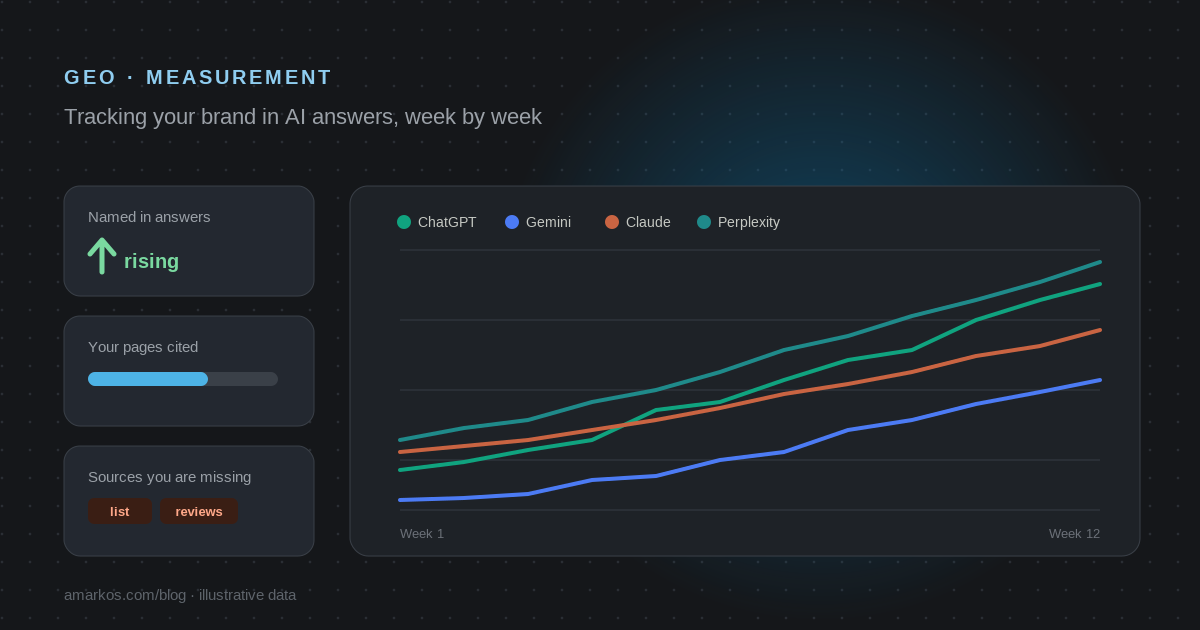
Re-ask the same questions regularly, ideally weekly, in each assistant. Track how often you are named, how prominently, which sources are cited and whether the description is accurate. Expect movement to be gradual: assistants refresh what they read at different speeds, and answers vary from one ask to the next. Our post on how to measure GEO sets out a full method.
How Amarkos helps
Amarkos is an agentic marketing platform for SEO and GEO. Every week its AI agents ask ChatGPT, Gemini, Claude and Perplexity your customers' questions, record who is named and which sources are cited, and turn the sources you are missing from into outreach targets. They then pitch each author personally from your own mailbox and keep track of what changes. See AI search visibility or run a free AI audit to start.
Put one customer question to ChatGPT, Perplexity and Gemini with live search, and see who they name and which pages they cite.
Questions
Do brand mentions without links help SEO?
For classic Google rankings, an unlinked mention does much less than a link. For AI answers, it can matter a lot, because assistants read the text of the pages they use. A specific, accurate mention in a source the assistants trust helps you be named, linked or not.
How do I get mentioned on "best of" lists?
Find the lists that rank for your category and that assistants cite, then write to the named author with the facts they need to include you: what you do, who it is for, how it differs, pricing and a way to try it. Offer to make their article more complete rather than asking for a ranking.
Can I pay to be mentioned by ChatGPT or Gemini?
No. There is no way to pay an assistant to name you in its organic answers. What you can do is earn accurate mentions in the sources the assistants read, keep your own facts clear and consistent, and make sure AI crawlers can read your site.
How long does it take for new mentions to show up in AI answers?
It varies. Assistants that search the web live can pick up a new source quickly once it ranks or is indexed. What a model learned in training changes only when the model is updated. Track the same questions weekly and expect a gradual trend rather than an overnight change.